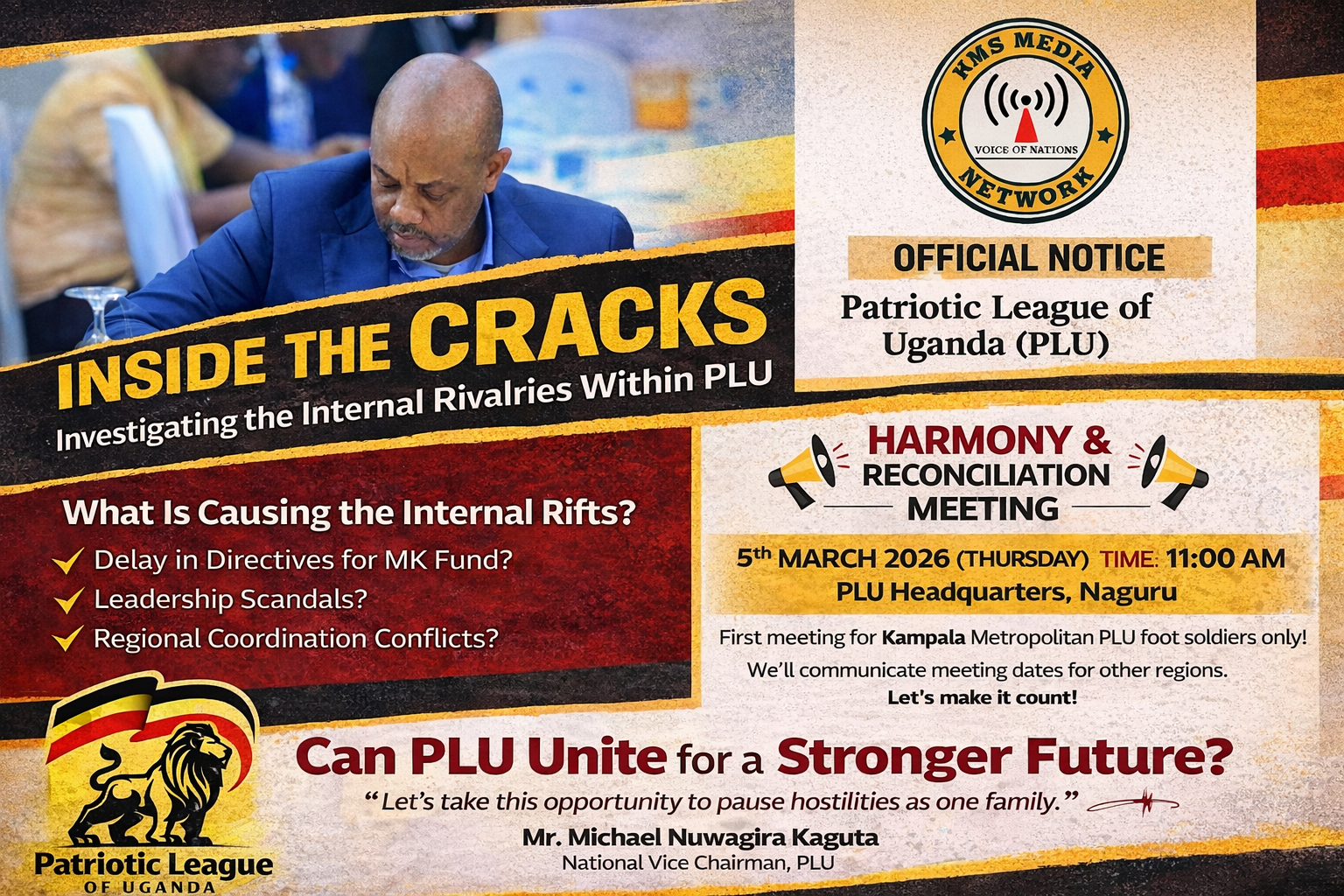

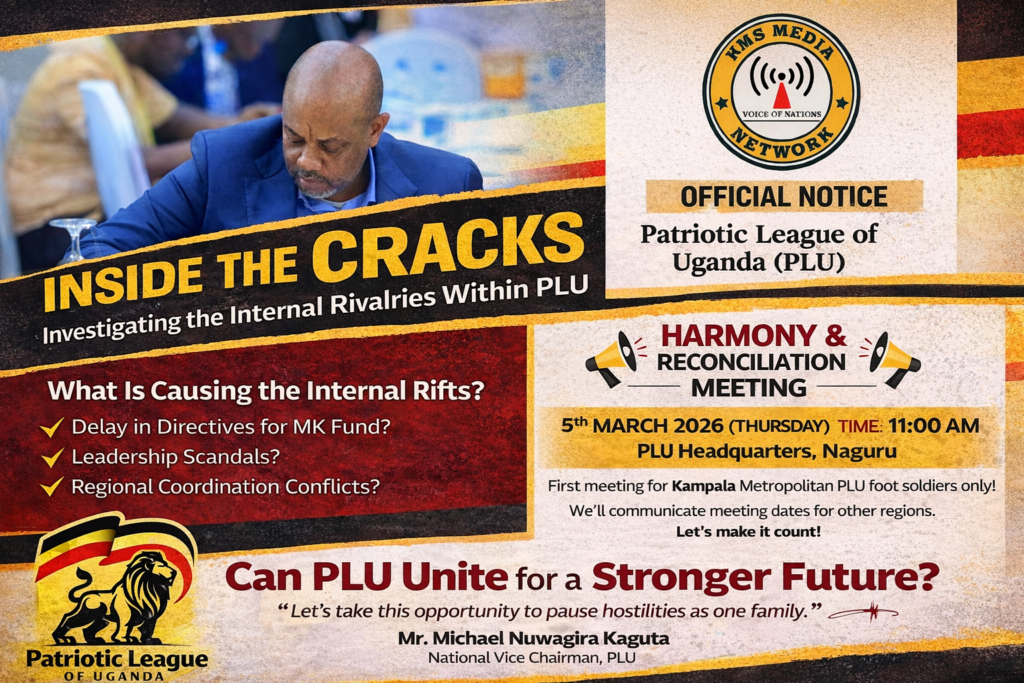
When the National Vice Chairman of the Patriotic League of Uganda, Mr. Michael Nuwagira Kaguta, issued an urgent call for a “ceasefire” and a Harmony and Reconciliation Meeting at the Naguru headquarters on 5th March 2026 at 11:00am, it was more than routine party mobilization. It was an acknowledgment that internal tensions within PLU have reached a level that requires structured intervention.
But what exactly is driving these rivalries?
Is it delayed directives concerning the MK Fund? Is it leadership scandals? Or is it a deeper struggle over identity, structure, and future direction?
KMS Media conducted exclusive interviews with foot soldiers in Kampala Metropolitan areas, reviewed internal communications, and analyzed recent developments to uncover the underlying fault lines.
1. The MK Fund Question: Delayed Directives and Growing Suspicion
One of the most frequently cited concerns among foot soldiers is uncertainty surrounding the MK Fund, its operational structure, oversight, and disbursement criteria.
Supporters aligned with PLU Chairman Gen. Muhoozi Kainerugaba have long viewed the MK Fund as a mobilization engine and empowerment tool. However, multiple grassroots coordinators say:
- There are inconsistent guidelines on how funds are accessed.
- Communication gaps exist between national leadership and grassroot coordinators.
- Some regions reportedly feel sidelined.
In political movements built on loyalty and mobilization, perception matters as much as policy. Delays or lack of clarity can easily morph into narratives of favoritism or exclusion whether grounded in fact or fueled by rumor.
Without transparent frameworks and consistent messaging, suspicion thrives.
2. Leadership Scandals and the Politics of Whisper Campaigns
While no major scandal has officially fractured PLU at the top level, insiders point to:
- Allegations of self-positioning for future parliamentary and national influence.
- Competition for proximity to the Chairman.
- Claims of “gatekeeping” around decision-making circles.
Movements in transition phases often struggle with internal hierarchy. PLU, which has grown rapidly in visibility and national relevance, now faces the classic challenge: institutionalizing charisma.
When structures lag behind popularity, rivalries emerge.
3. The Kampala Factor: Why the Metropolitan Region Is Key
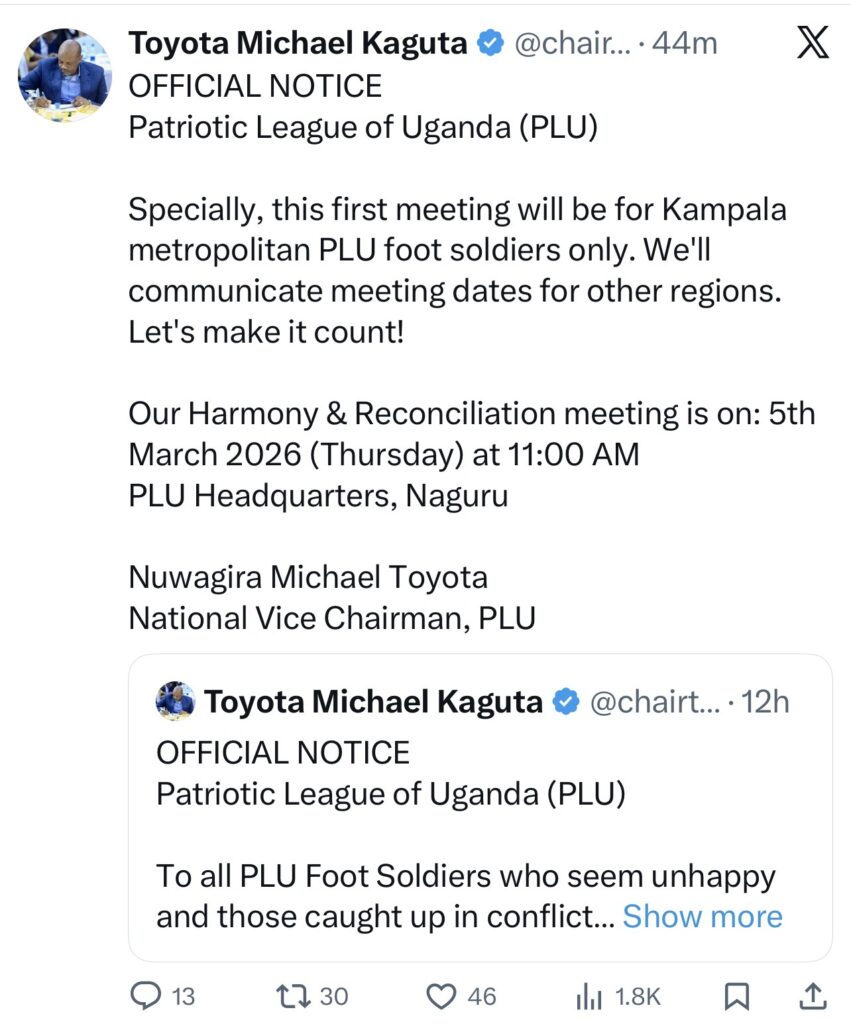
The Vice Chairman’s notice specifically targeted Kampala Metropolitan foot soldiers first.
That is not accidental.
Kampala remains:
- The communication nerve center.
- The social media battleground.
- The symbolic political arena.
Internal conflicts here amplify faster and louder than in other regions. If unity fails in Kampala, the ripple effect could undermine regional confidence.
4. What PLU Foot Soldiers Actually Want
Through observation interviews and online reviews, four consistent demands emerged:
1. Clear Command Structure
Foot soldiers want clarity on:
- Who issues directives?
- Who resolves disputes?
- What is the disciplinary process?
2. Transparent Resource Allocation
If the MK Fund is central to mobilization, supporters want:
- Publicized criteria.
- Regional balance.
- Accountability mechanisms.
3. Recognition and Inclusion
Many grassroots mobilizers feel used during peak campaigns and mobilization for Gen Muhoozi Kainerugaba presidential bid but ignored afterward.
4. Political Roadmap
Where is PLU headed? Civic movement? Political party? Transitional vehicle?
Ambiguity breeds rivalry.
5. The Vice Chairman’s Ceasefire Call: Strategic or Reactive?
The language used by Mr. Michael Nuwagira Kaguta is telling:
- “Ceasefire”
- “Pause hostilities”
- “Heal and come together as one family”
Such terminology suggests tensions are not merely administrative, they are emotional and factional.
By limiting the first meeting to Kampala Metropolitan foot soldiers, leadership may be attempting a controlled pilot reconciliation model before rolling out nationally.
6. How PLU Can Unite: Recommendations from Political Analysts
Based on internal assessments and comparative political movement studies, here are strategic options:
A. Establish a Formal Conflict Resolution Desk
An internal ombudsman or ethics committee can prevent disputes from escalating publicly.
B. Issue a Transparent MK Fund Policy Paper
Clear guidelines will neutralize speculation.
C. Decentralize Communication
Monthly regional briefings (physical or digital) could reduce rumor cycles.
D. Define the Movement’s Ideological Identity
PLU must articulate:
- Is it reformist?
- Transitional?
- Generational?
- Institutional?
Movements without ideological anchors often fracture along personality lines.
7. The Bigger Question: Growing Pains or Structural Crisis?
Every fast-growing political movement faces two tests:
- Loyalty management.
- Institutional maturity.
PLU’s internal rivalries may simply reflect expansion stress. However, failure to address them decisively could:
- Fragment grassroots energy.
- Create parallel power centers.
- Damage national credibility.
The Harmony and Reconciliation Meeting on March 5th at Naguru will therefore serve as a litmus test.
Will it produce structured reforms?
Or merely temporary calm?
Conclusion: What PLU Supporters Need Now
PLU foot soldiers are not demanding perfection.
They are demanding:
- Direction.
- Fairness.
- Communication.
- Inclusion.
The Vice Chairman’s call is a step. But reconciliation must move beyond rhetoric into institutional reform.
The future of the Patriotic League of Uganda may depend less on external opposition and more on how it manages its own internal cohesion.
As one Kampala mobilizer put it:
“We are ready to fight for the movement. But we must feel the movement is fighting for all of us equally.”
The coming days will determine whether PLU transforms its internal tensions into unity or allows rivalry to define its next chapter.