
When General Muhoozi Kainerugaba publicly “requested” that Hon Norbert Mao steps back from a potential Speakership bid, the message appeared simple almost brotherly. But in Uganda’s layered power layout, such statements are rarely casual. They are coded, calculated, and often consequential.
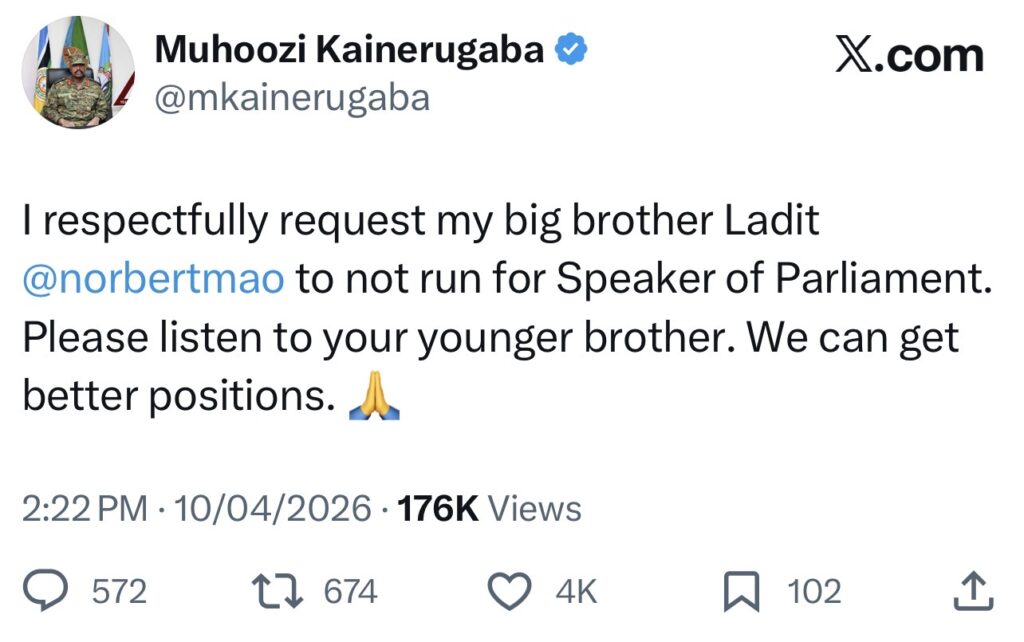
“I respectfully request my big brother Ladit @norbertmao to not run for Speaker of Parliament. Please listen to your younger brother. We can get better positions.”
This single tweet has ignited multiple interpretations across political circles. At its core lies a fundamental question: What did General Muhoozi really mean and for whom was the message intended?
A Friendly Warning or a Strategic Block
At face value, General Muhoozi’s tone is polite, even deferential. Yet the substance suggests restraint, not encouragement. By asking Mao not to run, he effectively signals that the Speakership may already be politically “reserved” or strategically sensitive.
This raises a key possibility:
Gen.Muhoozi is not promoting Hon.Mao but cautioning him against a losing or disruptive bid.
In Uganda’s ruling ecosystem dominated by National Resistance Movement (NRM), the Speakership is not merely an elective post it is a strategic pillar of regime stability. Any external contender, even one cooperating with government, risks upsetting internal balances.
The “Better Position” Clause: Promise or Deflection
The most revealing line is not the request it is the promise:
“We can get better positions.”
This suggests:
- Mao is being offered something in exchange for stepping aside
- The “better position” is likely executive, not legislative
- Negotiations may already be underway behind closed doors
Here, Gen.Muhoozi appears less like an individual actor and more like a messenger of an internal consensus or even a negotiator.
Is This President Museveni Speaking Through Gen.Muhoozi
In Uganda’s political reality, it is difficult to separate Gen.Muhoozi from his father, President Yoweri Kaguta Museveni.
This raises a critical interpretation:
The tweet could be an informal extension of presidential thinking delivered through a softer, less official channel.
Why use Gen.Muhoozi instead of a formal party statement?
- It maintains plausible deniability
- It allows testing public reaction
- It avoids direct political confrontation with Hon.Mao
If true, this would mean Hon.Mao is being quietly told:
“The Speakership is not your path but stay within the system.”
Grooming Hon.Mao for Something Bigger
Another compelling angle is strategic inclusion.
Hon.Mao, as leader of the Democratic Party, represents a historic opposition bloc. His cooperation agreement with NRM already stirred controversy within opposition ranks.
Gen.Muhoozi’s message may signal:
A long-term integration plan for Hon.Mao within the ruling establishment
Possible scenarios:
- A senior cabinet role
- A constitutional or transitional role
- Even positioning within a post-Museveni political order
In this sense, blocking Hon.Mao from the Speakership may not be rejection, it may be preservation for a more strategic assignment.
Is it a Move to Protect NRM Internal Interests
There is also a less diplomatic interpretation:
Gen.Muhoozi is defending internal NRM candidates and power structures
The Speakership race is deeply tied to:
- Parliamentary loyalty
- Patronage networks
- Succession politics
Allowing Hon.Mao a non-NRM figure to take such a position could:
- Weaken internal cohesion
- Create parallel power centers
- Complicate future succession plans, including Gen.Muhoozi’s own perceived ambitions
In this reading, the tweet is a soft blockade disguised as brotherly advice.
Personal Voice or Political Instrument
Gen.Muhoozi has increasingly used social media as a political tool blending personal tone with strategic messaging. His style often:
- Humanizes power
- Masks authority in informality
- Delivers serious signals in casual language
This tweet fits that pattern perfectly.
It is informal in tone, but formal in implication.
So, What Is the Real Logic
The truth likely lies at the intersection of all these interpretations:
- Yes, it discourages Hon.Mao’s Speakership bid
- Yes, it hints at alternative rewards
- Yes, it may reflect broader state thinking
- And yes, it protects internal regime calculations
The most plausible conclusion:
Gen.Muhoozi’s tweet is not an endorsement it is a controlled political signal.
It tells Hon.Mao:
- Step back from Speakership race of Parliament
- Stay aligned with power
- Wait for a more strategic opportunity
Final Insight: Power Speaks Softly in Uganda
In Uganda’s political system, the most important messages are rarely delivered through official statements; they come through signals, suggestions, and “requests.”
Gen.Muhoozi’s tweet is one such signal.
Whether it is:
- A son echoing his father
- A strategist shaping alliances
- Or a power broker managing future transitions
One thing is clear:
It is not just a tweet, it is a move on the chessboard.