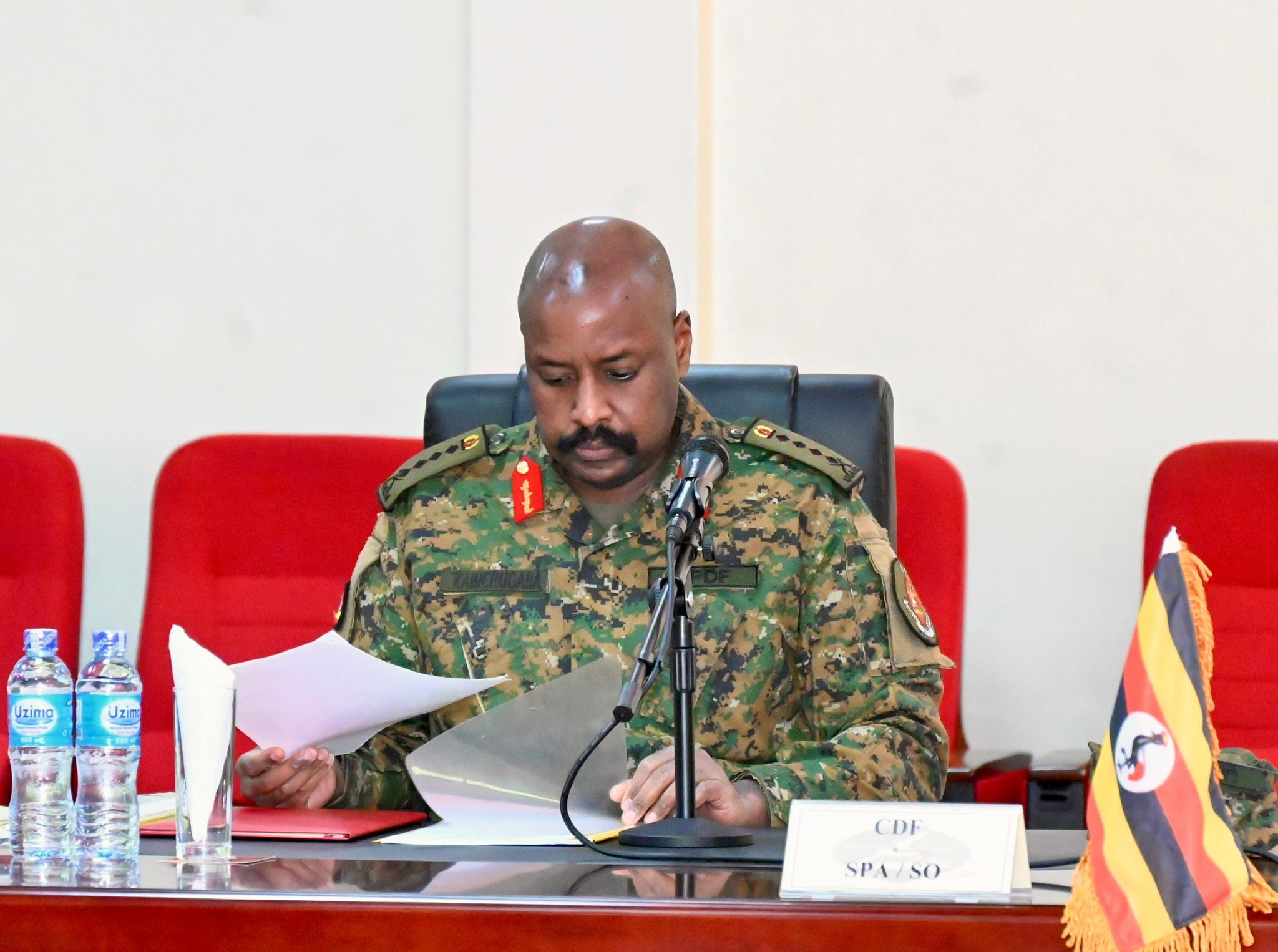

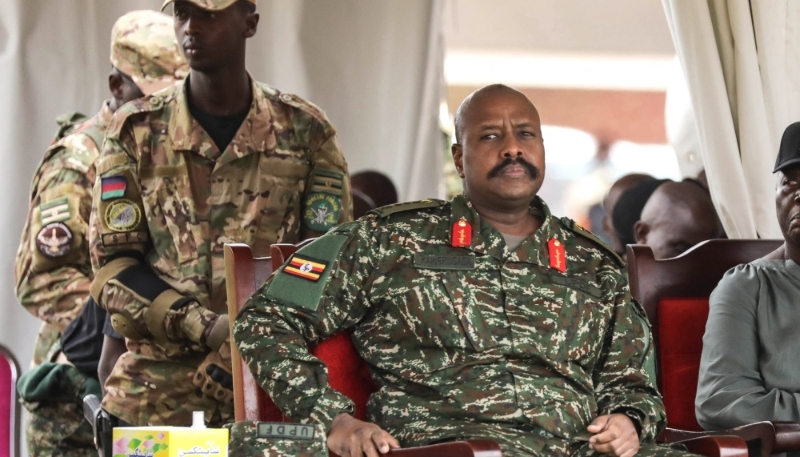
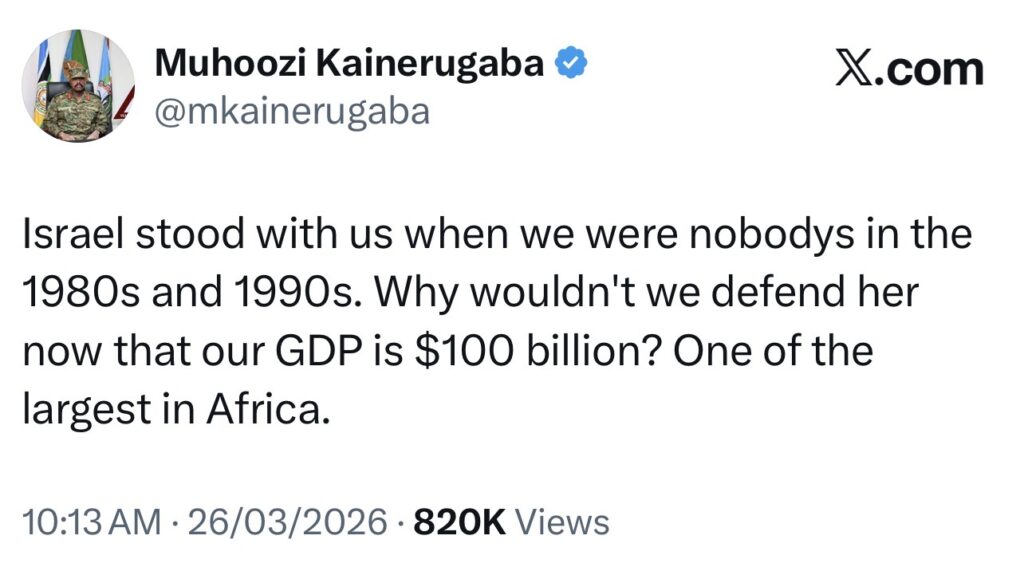
In late March 2026, The Chief of Defense Forces, General Muhoozi Kainerugaba, triggered both international attention and domestic scrutiny after a series of assertive posts on X (formerly Twitter) expressing Uganda’s unwavering support for Israel.
Shortly after, the General issued a striking warning:
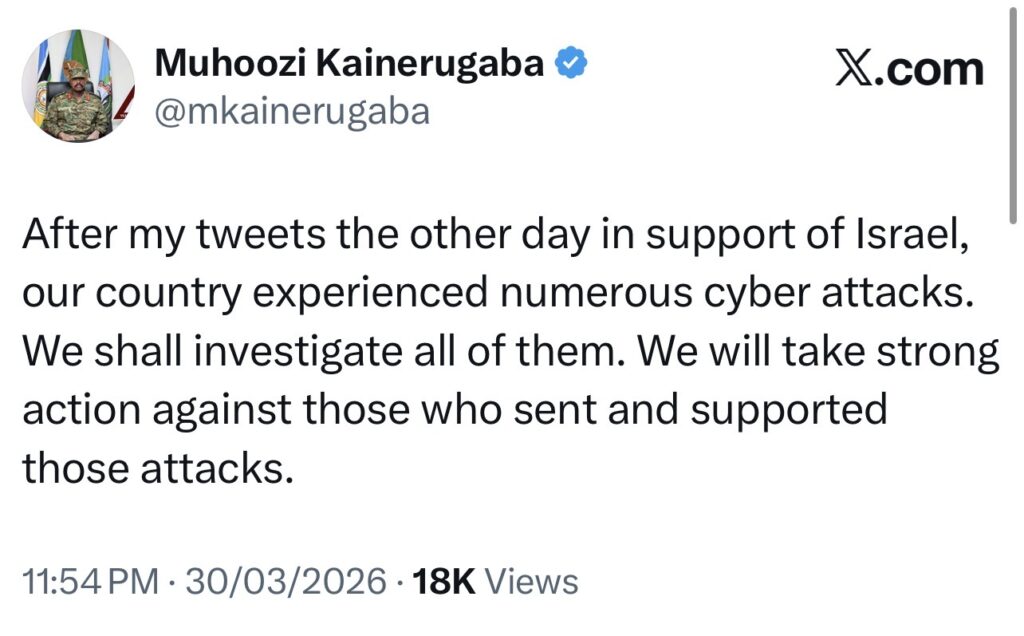
This declaration raises critical questions:
Were these cyber attacks real, coordinated, and politically motivated? Or are they part of a broader narrative shaping Uganda’s national security posture?
The Trigger: Uganda Enters a Global Narrative
Gen. Muhoozi’s original tweets did more than express solidarity, they projected Uganda into an ongoing geopolitical barrage involving Israel and its adversaries. He stated that any attempt to destroy Israel would draw Uganda into conflict on Israel’s side.
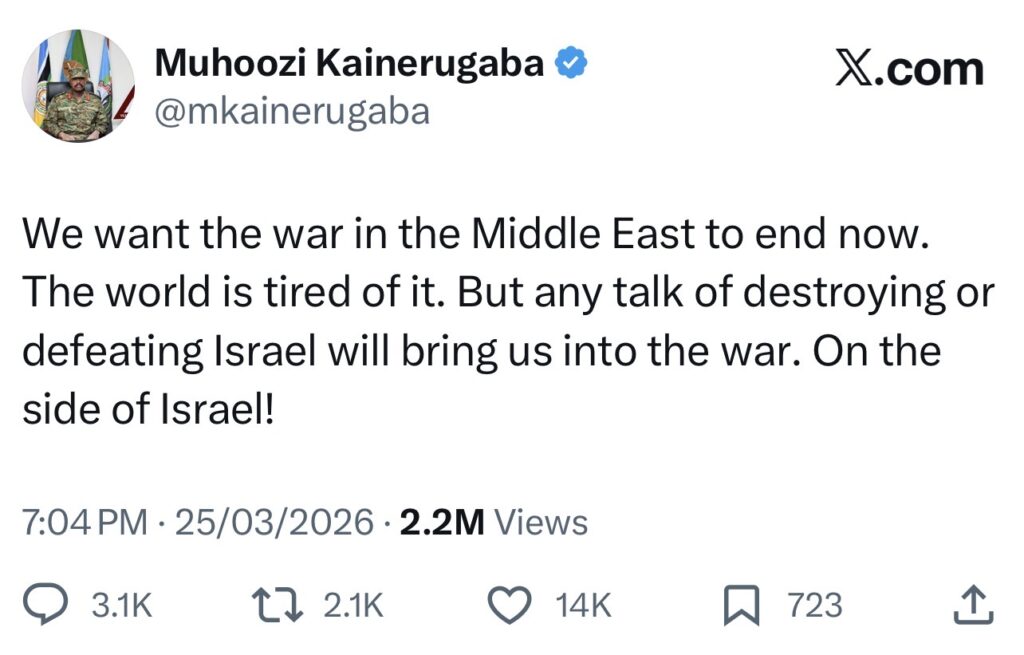
The remarks quickly went viral, drawing global attention and engagement across political, diplomatic, and intelligence circles.
From a strategic standpoint, such declarations especially from a serving military chief effectively reposition Uganda within a sensitive global axis of conflict.
The Cyber Attack: Signal or Strategy?
The most consequential element of Gen. Muhoozi’s follow-up statement is that Uganda experienced “numerous cyber attacks” immediately after his pro-Israel stance.
While no official technical report has yet been released by institutions such as the Uganda Communications Commission or the National Information Technology Authority (NITA-U), the allegation suggests three possible interpretations:
1. Retaliatory Cyber Activity
If verified, the attacks may represent asymmetric retaliation by hostile actors state or non-state aligned against Israel or its allies. In modern warfare, cyber operations are often used to:
- Disrupt government systems
- Probe national security infrastructure
- Send political warnings without physical confrontation
Uganda’s sudden vocal alignment could have made it a soft but symbolic target.
2. Cyber Probing, Not Full-Scale Attack
Cybersecurity experts often distinguish between:
- Scans and probes (routine but suspicious activity)
- Coordinated attacks (targeted disruption)
Without disclosed evidence, the “attacks” may fall into early-stage probing common after high-profile geopolitical statements.
3. Strategic Signaling by Leadership
The announcement itself may serve a deterrence function:
- Signaling that Uganda is alert and responsive
- Justifying increased cybersecurity measures
- Framing external threats to consolidate internal support
This aligns with Gen. Muhoozi’s history of using social media as both a political and strategic communication tool.
A Pattern of Digital-Statecraft
Gen. Muhoozi’s use of social media is not new. His posts have previously influenced diplomatic relations and sparked regional reactions.
What is emerging is a model of “digital-statecraft”, where:
- Tweets act as policy signals
- Online reactions trigger real-world security responses
- National defense narratives are shaped in real time
In this context, the cyber attack becomes part of a larger hybrid warfare narrative, blending information, perception, and security.
National Security Implications for Uganda
If the cyber attacks are confirmed, Uganda faces a new frontier of threats:
- Cyber Defense Gaps: Are national systems resilient enough?
- Policy Coordination: Is there a unified cyber response strategy?
- Diplomatic Fallout: Could Uganda’s stance draw it into indirect conflicts?
The CDF’s promise to “take strong action” suggests potential escalation not militarily, but through:
- Cyber countermeasures
- Intelligence investigations
- Strategic alliances
Regional and Global Reactions
Uganda’s pro-Israel stance has already placed it within a broader geopolitical discourse involving Middle East tensions.
If cyber attacks are linked to foreign actors, this could:
- Elevate Uganda’s role in global security dynamics
- Attract partnerships or scrutiny from international allies
- Redefine its traditionally cautious foreign policy posture
Conclusion: Between Threat and Narrative
Gen. Muhoozi Kainerugaba’s revelations of cyber attacks marks a pivotal moment where social media, geopolitics, and national security intersect.
Whether these attacks were:
- Real and coordinated
- Exaggerated but plausible
- Or strategically communicated
…the implications are significant.
Uganda now stands at a crossroads where a tweet has potentially:
- Invited digital confrontation
- Redefined foreign alignment
- And exposed the evolving nature of modern warfare
As General’s investigations unfold, one thing is certain:
In the digital age, declarations of loyalty can trigger battles far beyond the battlefield.