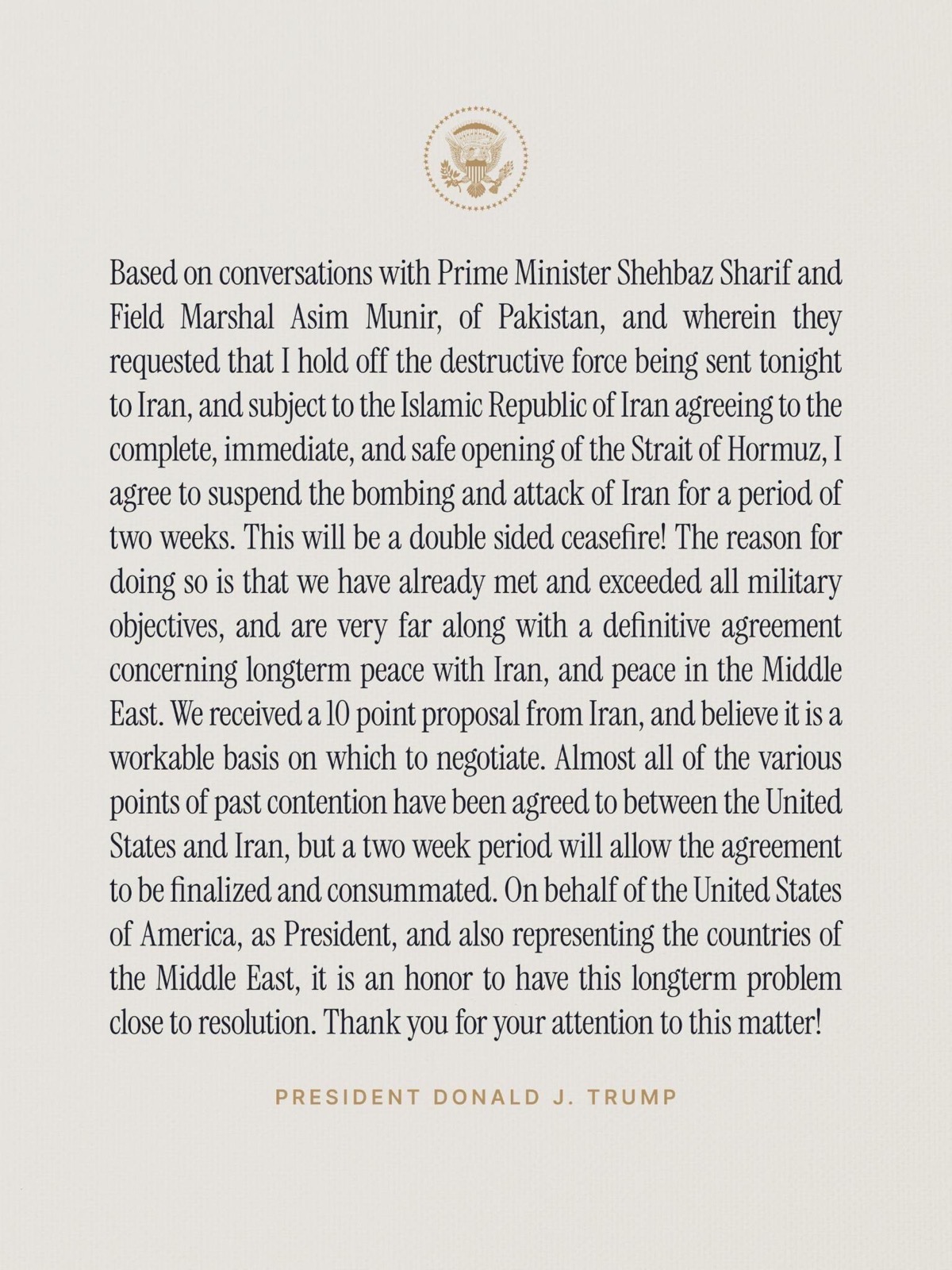

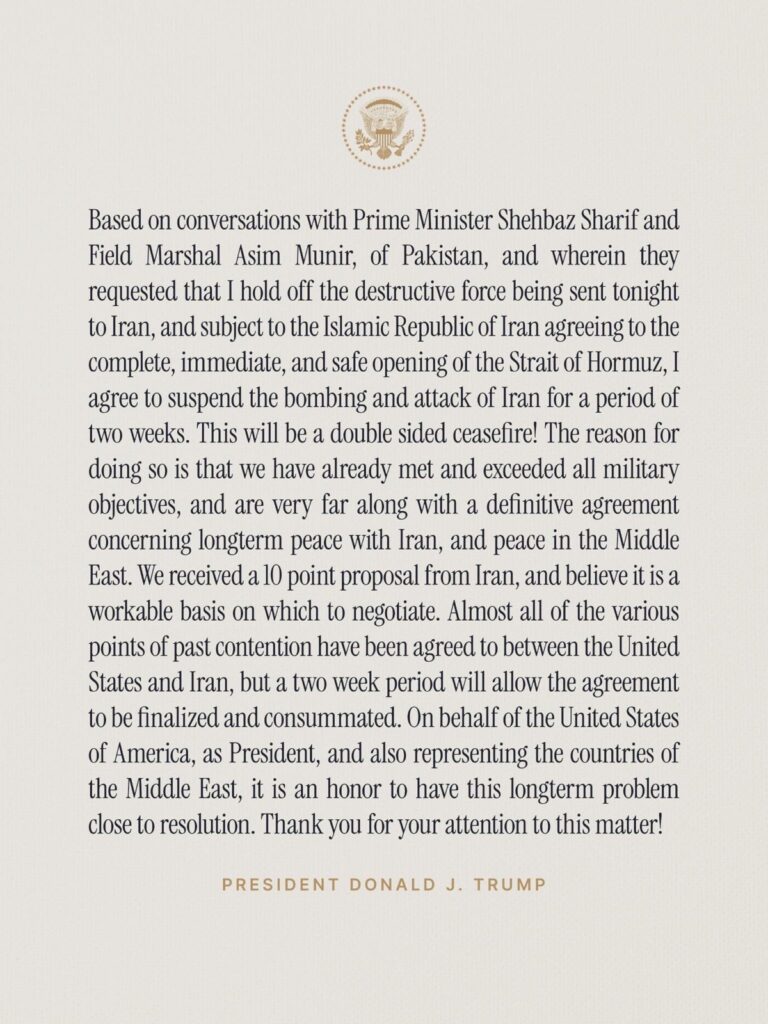
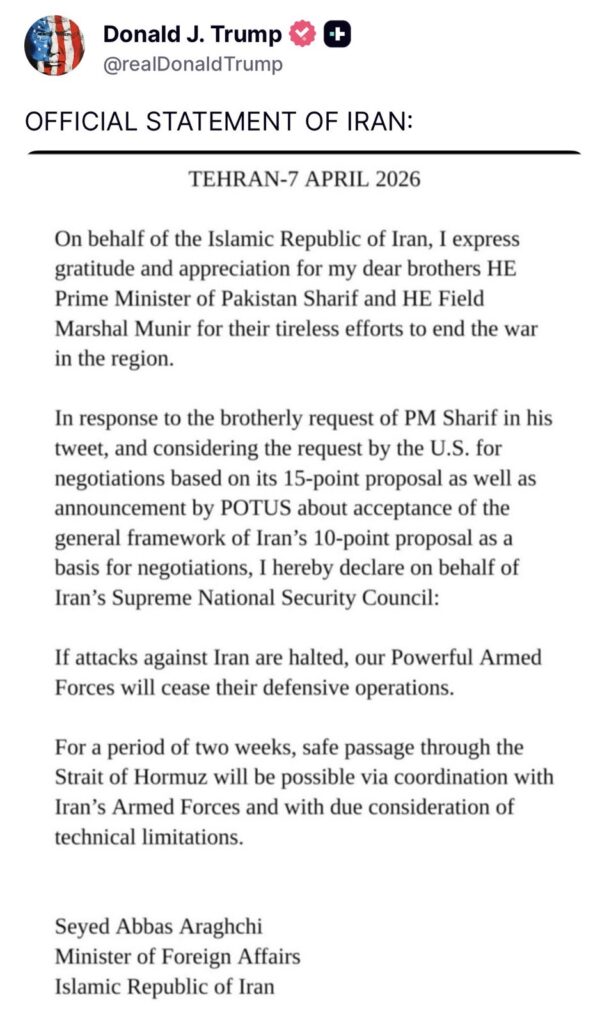
In a U- turn of events with far-reaching global implications, U.S. President Donald J. Trump has announced a two-week suspension of military action against Iran, following mediation efforts led by Shehbaz Sharif and Asim Munir. Tehran has reciprocated with a conditional halt to its defensive operations, signaling a rare moment of de-escalation in one of the world’s most volatile geopolitical flashpoints.
At the center of this fragile ceasefire lies a critical artery of global commerce “the Strait of Hormuz” and a high-stakes diplomatic gamble that could reshape the future of global security, energy markets, and international alliances.
A Strategic Pause, Not Peace
The announcement frames the ceasefire as a “double-sided” pause, with both Washington and Tehran accepting to progress toward a long-term peace. However, beneath the diplomatic language lies a complex reality: this is not yet peace, but a strategic recalibration.
Iran’s agreement to allow conditional passage through the Strait of Hormuz through which roughly one-fifth of the world’s oil supply flows signals its continued leverage over global energy security. In exchange, the U.S. halts what Trump described as “destructive force” already in motion.
The involvement of Pakistan is particularly notable. Islamabad’s leadership, traditionally aligned with both Western and regional interests, has positioned itself as a key intermediary and emerging diplomatic player in Middle Eastern conflict resolution.
Global Economic Shockwaves Averted For Now
The immediate effect of this ceasefire is a temporary easing of global economic anxiety. Had the Strait of Hormuz been fully closed or militarized, oil prices would likely have surged dramatically, triggering inflation spikes worldwide.
For developing economies particularly in Africa and parts of Asia, the consequences could have been severe: rising fuel costs, food insecurity, and currency instability. Uganda and its East African neighbors, heavily dependent on imported petroleum, would have felt the shock almost immediately.
This two-week window offers breathing space for global markets. However, the conditional nature of Iran’s cooperation means that uncertainty remains high. Investors and governments alike are watching closely.
A New Diplomatic Equation
Perhaps the most significant development is the apparent convergence of U.S. and Iranian negotiation frameworks, Washington’s 15-point proposal and Tehran’s 10-point plan. According to Trump’s statement, “almost all” contentious issues have been resolved, though details remain undisclosed.
If accurate, this would mark a historic breakthrough in relations between the two adversaries, whose tensions have shaped Middle Eastern geopolitics for decades. Key unresolved issues likely include nuclear oversight, sanctions relief, and regional proxy conflicts.
The two-week timeline is ambitious. Diplomatic history suggests that such deep-rooted conflicts rarely resolve quickly. Yet the urgency reflects the high stakes involved not just for the region, but for the world.
Risks of Collapse
Despite the optimism, the ceasefire is precarious. It is contingent on mutual restraint and technical coordination in the Strait of Hormuz. Any miscalculation military, political, or even accidental could unravel the agreement.
Moreover, internal political dynamics in both countries could complicate negotiations. Hardliners in Tehran and Washington may view concessions as weakness, potentially undermining progress.
Regional actors such as Gulf states and Israel also remain critical stakeholders, though notably absent from the current public framework.
What This Means for the Future
This moment represents both opportunity and risk for the global community.
If successful, the ceasefire could:
- Stabilize global energy markets
- Reduce the risk of a wider Middle East war
- Open new channels for international diplomacy
- Strengthen multilateral conflict resolution efforts
If it fails, however, the consequences could be severe:
- Renewed military escalation
- Disruption of global oil supply
- Economic instability worldwide
- Heightened geopolitical polarization
A Test of Leadership
Ultimately, this two-week pause is more than a ceasefire it is a test. A test of whether diplomacy can prevail over decades of distrust, whether emerging mediators like Pakistan can reshape global negotiations, and whether the world can step back from the brink of another major conflict.
For now, the guns are silent. But the clock is ticking.