

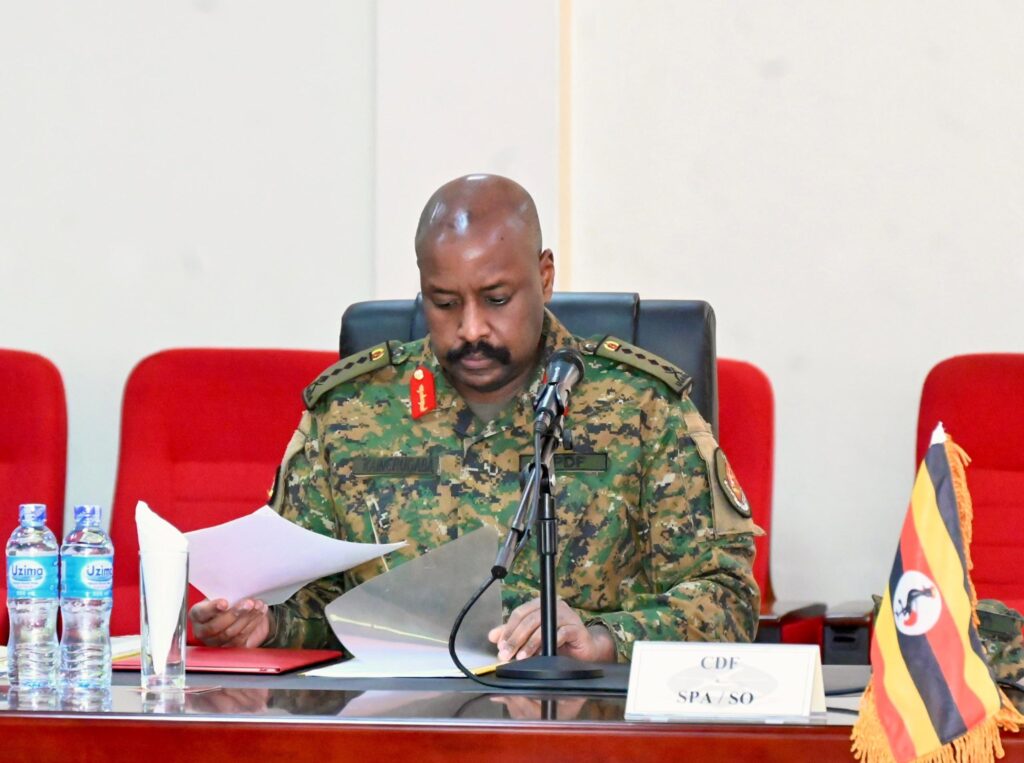
The recent public statements by General Muhoozi Kainerugaba offer one of the clearest windows yet into the evolving identity of the Patriotic League of Uganda (PLU). Taken together with two notable developments the halting of Patriotic Officer (PO) numbers at 020 and the apparent inaccessibility of the MK Fund since its announcement gives a deeper picture: PLU is transitioning from a loosely mobilized pressure movement into a tightly controlled ideological and organizational project.
This transition carries significant implications for its future.
Ideological Anchoring: Social Justice with Controlled Representation
At the heart of Gen. Muhoozi’s messaging is a defining ideological statement:
“Social justice in a representative government.”
This positions PLU within a hybrid political identity part revolutionary movement, part structured governance actor. The emphasis on representation suggests eventual political participation, while social justice signals an appeal to broad-based legitimacy, especially among youth and marginalized populations.
However, this is not a liberal interpretation of representation. His other statements suggest a guided democracy model, where participation exists but within a controlled ideological framework.

The Cadre System vs. Populist Mobilization
One of the most revealing distinctions Gen. Muhoozi draws is between:
- “Foot soldiers” (which he associates with opposition movements like National Unity Platform)
- “Patriotic Officers (POs)” and “Patriotic Cadres (PCs)”
This is more than semantics, it reflects a deliberate rejection of mass populism in favor of structured political layering.
PLU is attempting to build:
- A disciplined ideological core (POs)
- A broader mobilization base (PCs)
This mirrors classical revolutionary movements where:
- Leadership is earned, numbered, and historically recognized
- Membership is hierarchical, not purely democratic
Why the PO Numbers Stopped at 020
The decision or outcome of stopping PO assignments at 020 is highly symbolic.
It suggests:
- A closed founding elite
- Preservation of historical legitimacy
- Prevention of internal dilution of authority
In political movements, early numbering systems often become:
- Marks of seniority and influence
- Tools of internal discipline
- Foundations for future power distribution
By halting at 020, Gen. Muhoozi may be:
- Cementing a core command structure
- Avoiding internal competition for elite status
- Creating a mythology of founding figures
This is a classic consolidation move not expansion.

The MK Fund Silence Strategy
The MK Fund, once announced as a potential financial backbone of PLU, has notably lacked visibility and access.
This raises two possible interpretations:
1. Strategic Financial Centralization
The fund may be intentionally:
- Restricted to inner-circle control
- Shielded from public scrutiny
- Reserved for high-level political operations
2. Organizational Fragility
Alternatively, may be, the lack of access could indicate:
- Unresolved governance structures
- Trust deficits within the movement
- A gap between mobilization rhetoric and institutional capacity
Either way, the MK Fund’s silence contrasts sharply with the claim of 4 million members, raising questions about scalability and sustainability.

Membership vs. Organizational Reality
The assertion that PLU has “at least 4,000,000 members” is politically powerful but analytically complex.
If true, it suggests:
- Massive grassroots penetration
- Strong digital and ideological mobilization
However, without:
- Transparent structures
- Functional funding mechanisms
- Open participation channels
Such numbers risk being:
- Symbolic rather than operational
- Mobilizational rather than institutional
Controlled Internal Democracy: Voting, But Not Yet
Gen. Muhoozi’s statement on voting is particularly telling:
“When we start voting for positions all cadres will have a vote.”
This indicates:
- Voting is planned but not immediate
- Current leadership is appointed, not elected
- Internal democracy is sequenced, not foundational
This reinforces the idea that PLU is in a pre-institutional phase, where:
- Discipline precedes democracy
- Structure precedes participation
Moral and Intellectual Gatekeeping
The comment about requiring a theological degree to lead a church may appear unrelated, but it reflects a broader philosophy:
- Leadership should be credentialed
- Authority should be earned intellectually
- Institutions must be protected from populist capture
Applied politically, this suggests PLU may favor:
- Technocratic leadership
- Merit-based hierarchy
- Ideological vetting

Conclusion: A Movement Building Power Before Opening Up
Gen. Muhoozi Kainerugaba’s vision for PLU is becoming clearer:
- Not a loose populist movement
- Not yet a fully democratic party
- But a structured, ideological, and centrally controlled political force in formation
The stoppage at PO 020 and the opacity around the MK Fund are not minor issues they are signals of intentional consolidation.
PLU’s future will likely depend on how it balances three tensions:
- Control vs. Participation
- Ideology vs. Inclusivity
- Mobilization vs. Institutionalization
If it succeeds, it could evolve into a disciplined political machine with national reach.
If it fails, it risks becoming a symbolically large but structurally shallow movement.
Either way, Gen. Muhoozi remains the central axis both the movement’s greatest strength and its most defining variable.