
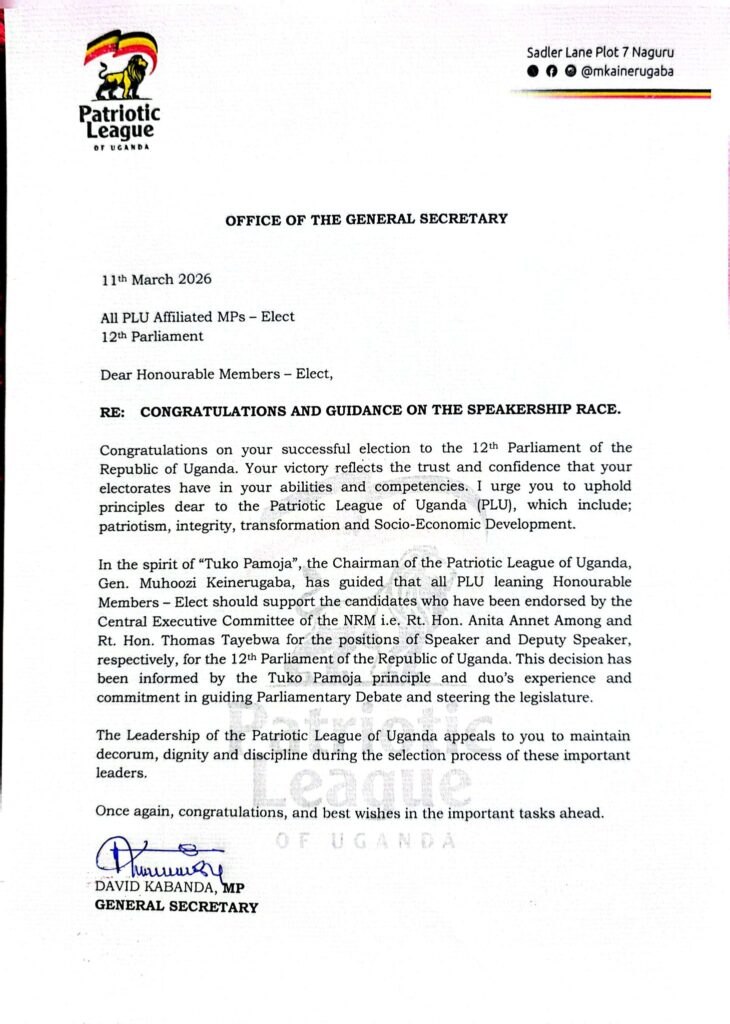
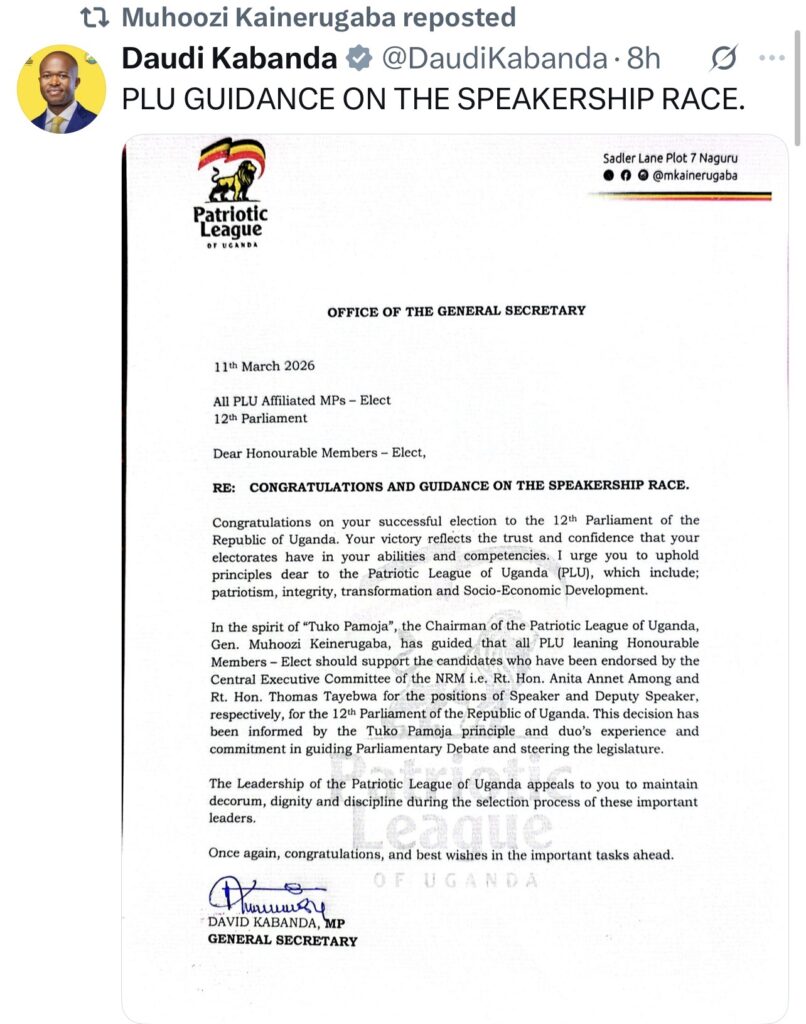
A letter dated 11 March 2026, issued from Sadler Lane, Naguru in Kampala, is quietly drawing attention within Uganda’s political circles. Addressed to Members of Parliament–Elect affiliated with the Patriotic League of Uganda (PLU), the communication offers congratulations but also delivers a clear message regarding the upcoming race for parliamentary leadership.
Signed by PLU General Secretary Hon.David Kabanda, the letter urges PLU-leaning MPs to support the candidates endorsed by the Central Executive Committee of the National Resistance Movement. Those candidates are Rt.Hon. Anita Annet Among for Speaker and Hon.Thomas Tayebwa for Deputy Speaker of the 12th Parliament.
While the message appears routine on the surface, political observers say it carries deeper implications about emerging power dynamics in Uganda’s political landscape.
A Message of Unity and Strategy
The letter invokes the principle “Tuko Pamoja” Swahili for “We are together” which has increasingly become associated with the leadership philosophy of PLU Chairman General Muhoozi Kainerugaba.
By directing PLU-affiliated legislators to support the NRM-endorsed candidates, the organization appears to be sending a signal of unity within the broader pro-government political structure.
The message helps prevent potential divisions during one of the most sensitive internal processes of Parliament the election of its Speaker and Deputy Speaker.
“The speakership race is one of the most powerful contests within Uganda’s governance system,” one political observer told KMS Media. “Any guidance issued ahead of it reflects strategic political coordination.”
PLU’s Growing Political Footprint
Although the Patriotic League of Uganda initially emerged as a platform promoting patriotism and civic mobilization, its influence appears to be expanding into structured political engagement.
The letter highlights several key indicators of this shift.
First, it acknowledges the existence of “PLU leaning MPs–Elect,” suggesting the movement now has identifiable allies within the national legislature.
Second, it demonstrates that the organization is capable of communicating directly with elected leaders and offering political direction during critical moments.
Third, it reinforces the leadership role of Gen. Muhoozi Kainerugaba in shaping the organization’s strategic messaging.
These developments suggest that PLU is evolving beyond a social movement into a platform that interacts with formal state institutions.

Reinforcing the NRM Political Line
Another significant aspect of the letter is its clear alignment with the decision of the National Resistance Movement Central Executive Committee.
By supporting the CEC-endorsed candidates Rt. Hon. Anita Among and Hon. Thomas Tayebwa, PLU appears to be positioning itself not as a rival structure but as a supportive force within the ruling political ecosystem.
In practical terms, this alignment could help consolidate the ruling party’s voting strength within the 12th Parliament.
The message also urges MPs to maintain “decorum, dignity and discipline” during the leadership selection process, an appeal that underscores the importance of unity during internal parliamentary elections.
What It Means for the 12th Parliament
The letter may seem simple, but its implications could be far-reaching.
If PLU-affiliated MPs follow the guidance issued from Sadler Lane, the outcome of the parliamentary leadership race may become more predictable. It would also demonstrate the organization’s ability to influence political alignment within Parliament.
At the same time, the development highlights the increasing visibility of PLU within Uganda’s governance discourse.
For political observers, the key question is whether the organization will continue expanding its influence within national institutions or remain primarily a mobilization platform supporting the broader government agenda.
A Sign of Emerging Political Networks
Uganda’s political system has long been shaped by formal institutions such as Parliament and political parties. However, informal networks and movements have also played a role in shaping political outcomes.
The Sadler Lane letter illustrates how such networks can interact with formal political structures.
Whether this represents a temporary mobilization effort or the consolidation of a long-term political force remains to be seen.
But one thing is clear: as Uganda’s 12th Parliament prepares to take shape, the signals coming from the Patriotic League of Uganda headquarters in Naguru are unlikely to go unnoticed.