
As Uganda’s political landscape steadily shifts toward the next parliamentary cycle, attention is turning to one of the country’s most powerful office: The Speaker of Parliament. The position is not merely ceremonial. The Speaker determines the tone of debate, the independence of Parliament, and how effectively the legislature can check or support executive power.
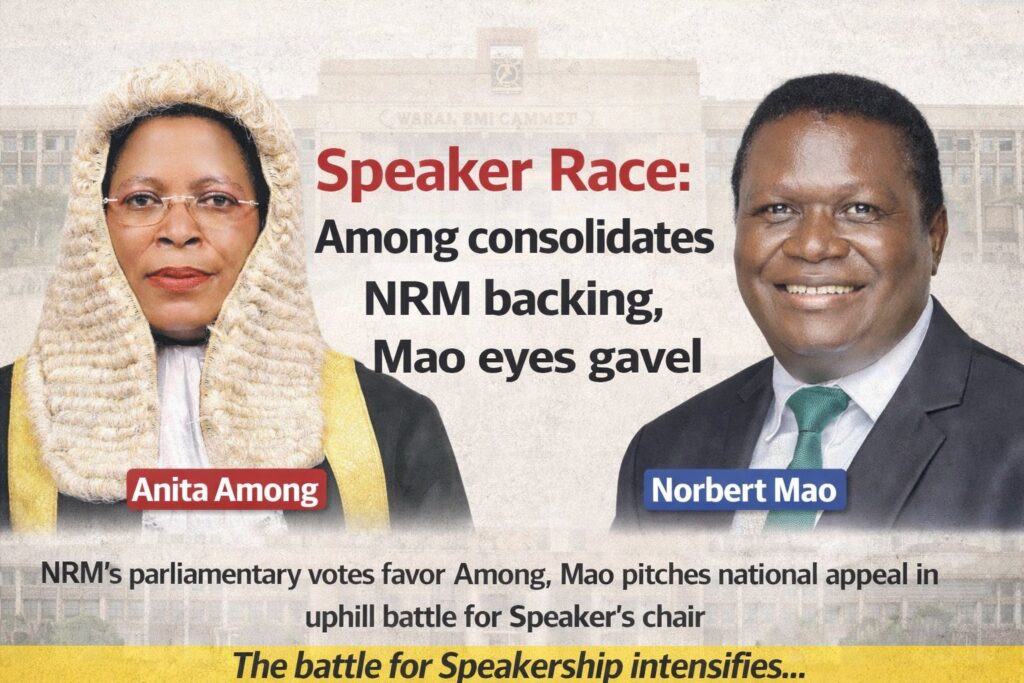
With the race beginning to take shape, two names are increasingly entering public conversation: Nobert Mao, who is positioning himself as a national consensus leader, and Anita Annet Among, whose standing is reinforced by approval within the ruling NRM structures, particularly among CEC members.
In a country where Parliament often becomes the arena for major national tensions, the Speaker must be both a referee and a stabilizer.
Anita Among: The NRM Establishment’s Preferred Continuity
Rt. Hon. Anita Annet Among enters the discussion from a position of strength. Her political advantage lies in one critical factor: NRM’s parliamentary dominance. With the ruling party controlling the majority of seats, its internal endorsement almost guarantees victory for its preferred candidate.
Why Among Appears Politically Secure
Among’s approval by NRM’s Central Executive Committee signals:
•Strong backing from the party machinery
•Confidence from top decision-makers
•Continuity in Parliament’s current direction
Her tenure has demonstrated loyalty to the ruling establishment while maintaining firm control over parliamentary business.
The Strength of Viability
In Ugandan politics, viability often outweighs popularity. Among’s candidacy is not just about experience — it is about numbers, networks, and institutional support.
Norbert Mao: A Push for National Relevance and Reformist Image
Norbert Mao’s interest introduces a different dynamic.
As a long-serving opposition figure turned political actor within government cooperation frameworks, Mao represents a more intellectual and national-leaning approach to leadership.
Mao’s Key Appeal
Mao brings:
•Strong oratory and legal-political grounding
•A history of multiparty engagement
•A reformist image to some Ugandans
•Broader appeal beyond one party base
His push could be interpreted as an attempt to redefine the Speaker’s role as more independent and nationally unifying.
The Challenge of Political Arithmetic
However, Mao faces one major obstacle: the Speaker’s office is ultimately decided by parliamentary majority. Without firm NRM endorsement, any non-establishment bid becomes difficult.
Fit to Lead: The Real Criteria
When assessing who is fit, Uganda must consider what Parliament needs most:
1. Independence vs Party Loyalty
Among offers stability within NRM dominance. Mao offers the possibility of a more plural voice.
2. Institutional Control
Among has proven administrative command. Mao offers intellectual leadership but less recent parliamentary operational control.
3. Political Acceptability
Among is acceptable to the ruling core. Mao remains a complex figure, admired by some, distrusted by others.
4. Public Confidence
Ugandans increasingly desire a Speaker who protects Parliament’s dignity and promotes accountability.
“Norbert Mao’s push may shape debate and present an alternative vision, but unless the ruling party fractures internally, his path remains uphill”
Conclusion: Who Is Fit?
If fitness is defined by political viability and institutional backing, Anita Among stands ahead.
If fitness is defined by national stature, reformist potential, and broader multiparty symbolism, Norbert Mao offers a compelling narrative.
Ultimately, Uganda’s next Speaker will not only reflect parliamentary leadership but the direction of Uganda’s democracy itself: continuity within the ruling system, or a renewed call for independence and balance.